
This guide covers how much nitrogen a St. Augustine lawn needs each year, what to look for on the label, when the first feeding belongs on the calendar and the rules that apply in Jacksonville and St. Johns County.
Want a lawn plan built for your property instead of a bag label? Ask RightWay to review your lawn.
How Much Fertilizer Does St. Augustine Grass Need in Northeast Florida?
UF/IFAS recommends 2 to 4 pounds of nitrogen per 1,000 square feet per year for St. Augustine grass in North Florida, which includes Jacksonville and St. Augustine. The City of Jacksonville's fertilizer rules use the same 2 to 4 pound range. A range is used because shade, soil, irrigation and how you handle clippings change what a lawn needs. These figures assume you recycle clippings by leaving them on the lawn.
Lower in the range suits a shaded or low-maintenance lawn. Higher suits full sun and a lawn you want to keep as dense as possible. More than that does not make the lawn greener for longer. It feeds thatch, fungus and pests.
When Should You Fertilize St. Augustine Grass in Jacksonville?
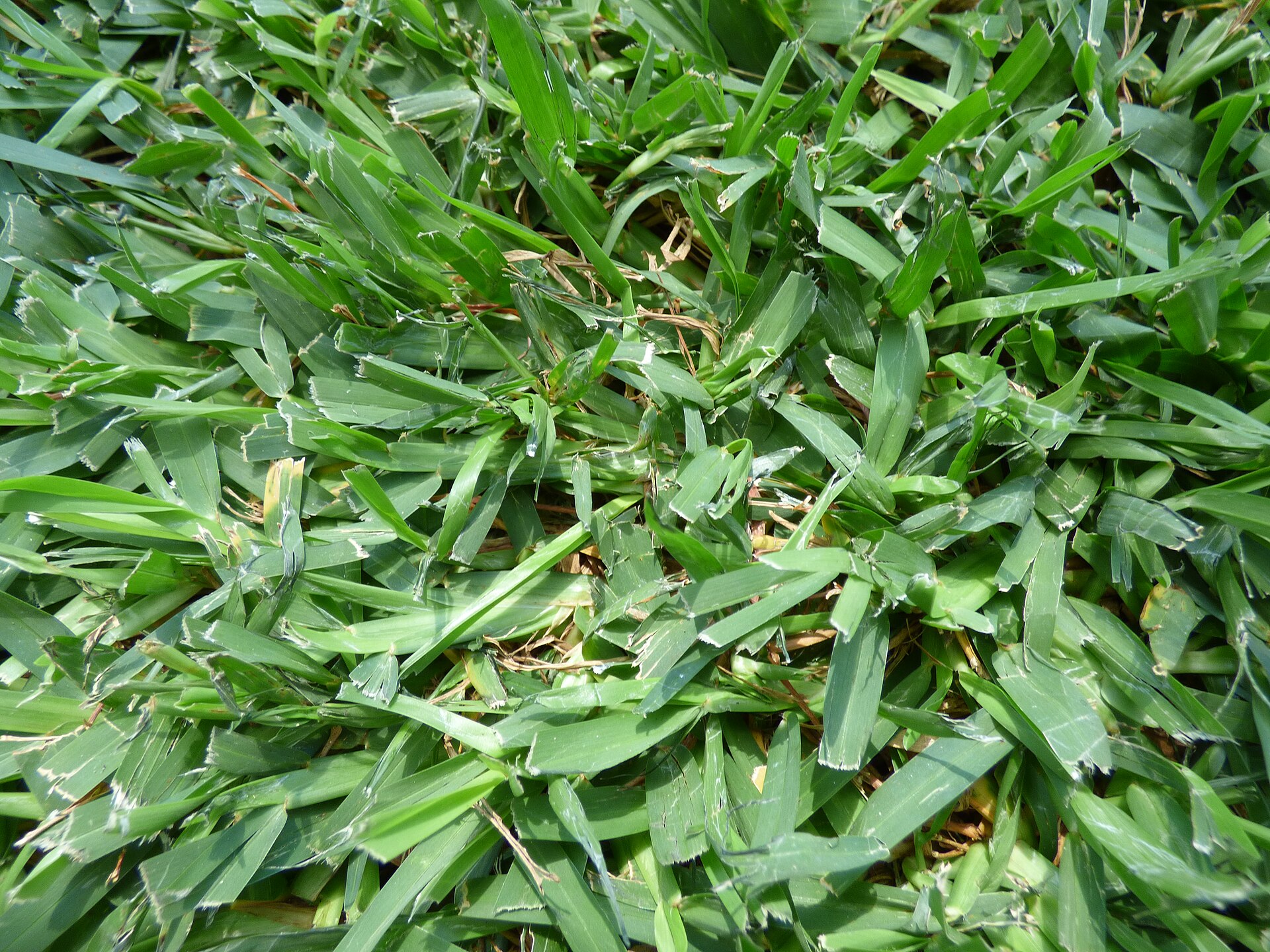
UF/IFAS says the first fertilizer application of the year in North Florida should be around mid-April, once the grass is actively growing, and warns against starting too early in the season, particularly in North Florida. Depending on location, the annual amount is split into 2 to 6 applications from spring green-up through fall. UF/IFAS also advises against fertilizing too late in the year, after growth has subsided.
Putting that together for Northeast Florida:
- Mid-April: first feeding once the lawn is growing strongly.
- Late spring through summer: one or two additional light feedings, spaced to stay within the yearly total for your lawn.
- Fall: UF/IFAS advises against fertilizing after growth has subsided. Skip heavy nitrogen as temperatures drop.
- Winter: pause nitrogen. See our winter lawn care guide for what to do instead.
As an example only: a homeowner aiming for 3 pounds of nitrogen a year using 1 pound per application would make three applications across the growing season, beginning in mid-April. Your lawn may call for fewer or more, and a professional will set timing from growth and weather rather than a fixed date.
Should You Fertilize During the Current Water Shortage?
Probably not until it passes. Duval and St. Johns County are under a Phase III water shortage, and UF/IFAS advises postponing fertilizer until a shortage is over, because a stressed lawn should not be pushed to grow. Lawn care professionals may still apply at low rates through a dry spell. Our guide to lawn watering restrictions in Jacksonville and St. Johns County covers the one-day-a-week schedule. Check whether the shortage is still in effect before you plan a spring feeding.
How to Choose a Fertilizer for St. Augustine Grass
Skip the marketing and read the three numbers on the bag. They show nitrogen, phosphorus and potassium, in that order. The City of Jacksonville recommends a Florida-friendly fertilizer with these features:
- Nitrogen and potassium close to equal: for example, 15-0-15.
- Phosphorus at 2 or less: the second number. Most Florida lawns do not need added phosphorus.
- At least 30 percent slow-release nitrogen: slow-release nitrogen feeds the lawn over time and is less likely to leach or run off. To work out the percentage, divide the slow-release nitrogen on the label by the total nitrogen and multiply by 100.
To find how much product delivers 1 pound of nitrogen per 1,000 square feet, divide 100 by the nitrogen percentage. A 15-0-15 bag needs about 6.7 pounds of product per 1,000 square feet.
Fertilizer Rules in Jacksonville
The City of Jacksonville's fertilizer ordinance applies to homeowners and professionals. The main limits are:
- Per application: no more than 1 pound of nitrogen per 1,000 square feet if the product has at least 30 percent slow-release nitrogen, and no more than 0.7 pound if it has less.
- Per year for St. Augustine grass: 2 to 4 pounds of nitrogen per 1,000 square feet.
- Phosphate: no more than 0.25 pound per 1,000 square feet per application and 0.50 pound per year, unless a soil test from UF or an accredited lab supports more.
- Do not apply during a flood watch or warning, a tropical storm watch or warning, inside the 3-day cone of uncertainty during a hurricane, or when heavy rain is expected.
- Water it in: apply about 1/4 inch of water after application to keep fertilizer from washing away.
- Near water: keep fertilizer 10 feet from ponds, canals, seawalls and wetlands, or 3 feet if you use a deflector shield or drop spreader. Keep a low-maintenance zone of at least 6 feet.
- Clean up: sweep fertilizer off driveways, sidewalks and streets right away and never rinse it into a storm drain.
Fertilizer Rules in St. Johns County
St. Johns County regulates fertilizer containing nitrogen and phosphorus to protect water quality. Its main guidelines are:
- Do not apply if a flood, tropical storm or hurricane watch or warning is in effect for the county, or if heavy rain is likely.
- Do not apply within 10 feet of surface water, or within 3 feet if you use a deflector shield or drop spreader.
- Keep annual nitrogen to no more than 5 pounds per 1,000 square feet, and less for some grasses.
- Commercial and institutional applicators must complete the Florida-Friendly Best Management Practices for Protection of Water Resources by the Green Industries training.
Cities within the county may add their own rules, so check with your municipality if you live in a city such as St. Augustine. Lawn care in Ponte Vedra and St. Johns County follows the county ordinance.
Common St. Augustine Fertilizer Mistakes
- Feeding too early or too late: pushing growth in cold or dry weather leaves tender grass exposed.
- Heavy quick-release nitrogen: it greens the lawn fast and feeds fungus. UF/IFAS advises slow-release nitrogen around disease periods. See our guide to large patch in St. Augustine grass.
- Ignoring the spreader: a rotary spreader without a deflector scatters fertilizer onto pavement and water.
- Fertilizing a lawn that is brown for another reason: chinch bugs, grubs and drought do not respond to fertilizer. Check first with our chinch bug guide.
- Treating the bag as a schedule: national labels are written for the whole country, not for Northeast Florida.
When to Call a Professional
- You are not sure what your lawn needs or which numbers to buy.
- Your lawn is thin or yellow even though you feed it.
- You have a large or irregular property and want the ordinance limits handled for you.
- You want treatment timing that follows growth and weather.
RightWay's lawn fertilization, weed control and lawn pest service follows Northeast Florida conditions rather than a national calendar. Share your address and what the lawn is doing and the team will tell you what it needs.
Sources
- UF/IFAS EDIS: Urban Turf Fertilizer Rule for Home Lawn Fertilization, ENH1089/EP353 (https://ask.ifas.ufl.edu/publication/EP353)
- UF/IFAS EDIS: St. Augustinegrass for Florida Lawns, ENH5/LH010 (https://ask.ifas.ufl.edu/publication/LH010) and the UF/IFAS Homeowners Guide to St. Augustinegrass Management in Florida
- City of Jacksonville: Irrigation and Fertilizer (https://www.jacksonville.gov/departments/office-of-administrative-services/environmental-quality/resources/irrigation-and-fertilizer)
- St. Johns County: Protect Our Water (https://www.sjcfl.us/protect-our-water/) and the county fertilizer restrictions flyer
- UF/IFAS Gardening Solutions: Lawn Management During Drought
- UF/IFAS Gardening Solutions: Large Patch in Florida Lawns